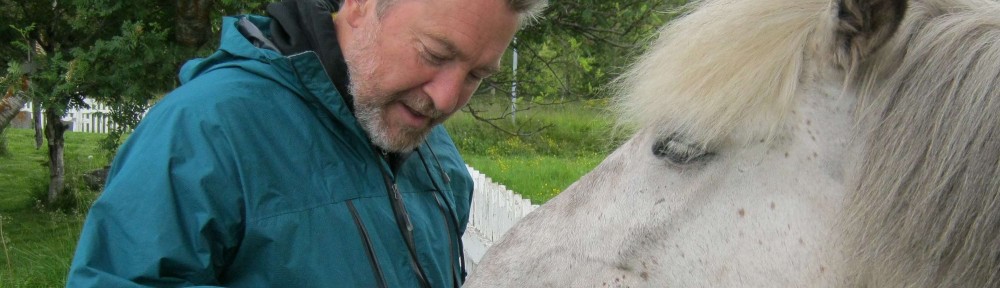
Over the years, Harold Rhenisch has taught many people the skills of writing, and the complementary skills of rewriting. He has worked with teachers, school and college students, and beginning and published writers, sharing the skills learned both under his own teachers, Robin Skelton, Charles Lillard, P.K. Page, Derk Wynand, W.D. Valgaardson, Eli Mandel, and Dave Godfrey, and the many other skills gained from long work and 100s of readings, as decade on decade he has worked at the art of writing with the support of other writers. He can offer you that support as well. If you are interested in having a helpful eye look over your work, drop him a line, and do check out his editing page. If you are interested in a group workshop, why not first check out a few of the workshops he has offered already.
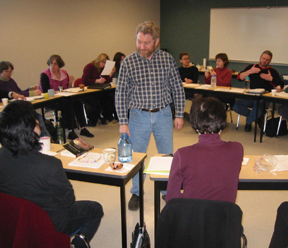
Harold in Prince Rupert
The Opening Paragraph – This is the one that counts.
Most short stories, novels, and works of creative non-fiction use the opening paragraph as an introduction to the main themes of the work, and especially to the sub-plot. In this linked (and fun!) series of exercises, students produce a short story, an opening paragraph, and a poem, based on the opening and closing sentences of a famous short story. Behind the fun is a piece of seriousness: a publisher who receives five manuscripts a day does not, really, have time to read them. Often, the first paragraph is the only one which is read. The purpose of this exercise is to increase your chances that it will be, as well as paragraph two, page two, chapter two, and right to the end.
Dialogue on Dialogue – Dialogue is the cleanest fuel.
To develop character, to drive plot, to keep the point of view clear, to set up symbolic resonance, to foreshadow, to develop irony, to develop character and tension, dialogue is the most versatile and powerful tool in a writer’s toolkit. In this workshop, you will learn how to use the tool, and what it is capable of doing.
The Art of Revision – Writing and revising are two separate arts.
Many books about writing discuss how to generate words. Few talk about what to do next. This workshop does just that. It starts from the premise that writing is an act of seeing the world through words, while revising is the act of seeing the words for what they are on the page. It is the art of possibilities.
A Colour Palette – Snow is not white. Water is not blue.
This series of exercises is designed to guide writers through the act of seeing. Just as a painter builds a palette out of a variety of media, applied on a variety of surfaces, with a variety of brushes and textures, this is the heart of writing, combining free association with close attention. When the words won’t come, this will lure them out.
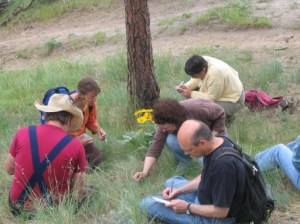
Out in the Kamloops air
Replacing Abstractions – Abstractions are useful shorthand. They are also doorways.
The language we speak is a colloquial language, a great distance from the one we use when we write. These exercises are designed to bring the two closer together, so that the large, abstract concepts we banter about connect directly to our lives and our world. History is in perception. So is philosophy. Writing is about how to live. In this workshop, I will show you how to open the door.
Imagery and Visual Poetry – We see with the body, but the mind writes. Not always!
Visual poetry and 20th Century traditions of imagery, Chinese translation and surrealism, Esperanto and sound poetry, all got their start during the First World War, then they went their own separate ways. I will show you how to put Humpty Dumpty together again, to use these separate arts to step away from writer’s block, to clarify the directions of your writing, and to speed up the process of discovery.
What is Creative Non-fiction – Creativity differs from invention.
Creative non-fiction is classically defined as non-fiction written using the techniques of fiction. Sounds great, but if you google around the virtual universe, you will quickly find that, on the ground, it often means a kind of sleepily jazzed-up journalism. Using the models of Kapuscinski, Chatwin, Lindqvist, Dillard, Magris, Glavin, Kishkan, Gayton and Rhenisch himself, this workshop explores a more fruitful foundation in notions of reading the world and of transformation.
Harold and the blackboard
A Question of Diction – Every word we write is an act of translation.
In this playful workshop, no word is sacred and no word is safe from being twisted into new shape, tickled, teased, caressed, thrown into deep water, or being put into a cake and asked to jump out singing salsa. Seriously, though, many beginning writers trip up otherwise powerful pieces by choosing words with different backgrounds. Our language, English, is a kind of United Nations, a kind of layer cake. This workshop show how to keep the cream out of the cherries, and the chocolate on top. For writers interested in translation, the workshop continues by showing how these techniques can be used to escape the straightjacket of expected readings, so that what is translated is not a dictionary, but a living voice.
Prayers and Spells – Poetry is sacred.
Poetry is not a literary art. It is older than that, and does direct work in the world. In this workshop, we do that work, together.
List Poetry – One thing leads to another.
From McFadden to Lorca, from Kroetsch to Heaney, from Homer to Strand and Pound to Lillard, one of the oldest forms of poetry is alive and well in our time. This workshop explores the tradition, and shows how it works, with a series of techniques that can break open the most difficult, closed-in ideas, into poems, dialogues, and even witty, accessible stories.
Trickster Work – The clown is the centre of the ceremony.
Tricksters are ofen associated with native spiritual traditions: Anansi, Coyote, Raven, Rabbit.They also, however, belong to Western traditions: Hermes, Falstaff, Puck,Mozart, Aristophanes, Eminem, Edson, and a thousand others, at least. This workshop explores the power of the trickster at the heart of all notions of identity and morality. Using the model of Bruce Chatwin’s The Songlines, it leads you to reading the world as story, and your story as the world. You will learn to make stories and poems like a pinata, and then to start swinging with a blindfold. You are allowed to cheat.
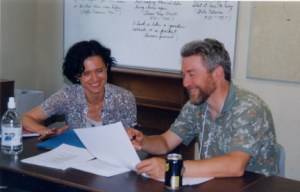
Harold and Leanne Boschmann at the Victoria School of Writing
Spiritual Writing – The world is a spiritual fire.
This workshop joins world spiritual traditions with the specific spiritual strengths of poetry. It is an act of liberation and reverence. For more information, please see my Spiritual Editing page.
A New Genre – The new genre of the 21st Century is amongst us.
Fiction that appears to be non-fiction, non-fiction that appears to be fiction, virtual work that appears to be real, work in real time which appears to be virtual, drama that appears to be social documentary, social documentary that masquerades as poetry, poetry that is constructed like drama: what is going on? Something new, that’s what. This workshop explores the roots of the new genre, maps out the world it is designed to support, and shows the forces lined up against it. The future is now.
From Marco Polo to Your Home Town – Travel to the ends of your metaphors.
Marco Polo went to China,came back to Venice, and wrote about it. Italo Calvino read Marco Polo, and wrote his masterpiece, Invisible Cities,based on Polo’s example.This workshop will show you how it is done, and how these techniques can be used to free you up to write about the world in which you live. It teaches the important skills of focus, and demonstrates how mythology and a naive voice can be used to great effect in showing the hidden connections in the seemingly everyday world.
 Harold Rhenisch
Harold Renish:
I was to take a marketing course from you on Saturday afternoon. Unfortunately the course has been cancelled.
I am told that you live, or are often in the vicinity of Campbell River. I live on Quadra Island.
I would be interested in consulting with you with regards to marketing my book “2000 days in China”.
If you do private consultations I would be interested.
I took a mentorship course from Jocelyn Reekie. Her comment was that my book is a barn burner and it must be published. Right now, it needs to be marketed!
regards
John and Cherie Hemmingsen
You make me laugh, so far, and think of Heyoka. I hope that this does not bother you, the thought is one of great sentiment and affords affection with the notion. You have so many things to read here, and so much INPUT!!! I am getting a migraine now–this causes my reading comprehension and word decoding to…crash! I will come back when the brain cooperates (or rather does what I wish of it, as it thinks it is functioning quite well as I am breathing still 🙂
I make myself laugh sometimes, too, so you’re in good shape. For something more peaceful, you can go for a trit trot over the hill with me, if you like: http://okanaganokanogan.com/2013/08/30/a-walk-through-the-grass-or-the-goddess-takes-many-forms/ Now, back to figuring out how to ride the horse of the sun with the stirrups on backwards. 😉