|
Harold Rhenisch
|
|
||||||||||||
|
Ronsdale
Press,
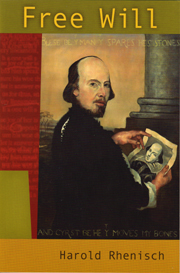
2004. ISBN: 1-55380-013-3. 99 pages.
$14.95 Obsessive and dark, Free Will twins Shakespeare with Fellini -- all the world's a stage where we're trapped as participant and witness at the precipice of time. This is a cultural ragbag, exuberant, vicioius and tender. Rhenisch says, 'To have a mind is madness,' and then goes on to show how it carves out survival. Marilyn Bowering. With this book, Harold Rhenisch confirms his status as one of the most inventive and witty poets on the Canadian scene, and while there are cognitive delights aplenty here, he has not sacrificed readability or accessibility to the making of this fine Mulligan stew. Richard Stevenson, The Danforth Review We are theatre, actors, clowns, and consequence, floored by Rhenisch's magnificent liturgy. Kat erina Fretwell, Prairie Fire
George Fetherling, The Vancouver Sun
while I, beside you, am a dwarf. I come up to your knees and grin. A minute ago I was fat and heavy and you were my twin, and further down the hall here in the dark we will both be impossibly thin, like two trees that have put on rags or two scarecrows in a garden, their blind eyes mad with birds, that whirl and peck the crop before we can take it in. We came here for some fun, so let's have it. Oh look, here around the corner our bones are bent, our heads don't sit where we're used to seeing them, but off to the side, and our spines, that should hold us up straight as our mothers always told us, tucking us in, are bent like lightning forking down to a lone elm in a field and splitting it. We should both fall down, but don't. We move on, straighten out, shrink, twist, and laugh at what we see, not because we're having fun but because I have forgotten what I am: man, or tree or twisted thing that jumps up in the dark. When I look at you, you're no help, as I'd hoped you'd be &emdash; the mirrors reflect you as well. We came in here knowing who we were, and still know it. It's who we are that's troubling. Things are what they seem. |
|
|||||||||||
Pun Intended
"The clown is the center of the ceremony"
Stefan Schütz, Peyote
This book began in 1975, when I drove off the farm to Victoria in a 1957 Ford Sedan with four colours of paint and a bullet hole in the back window. Who knows where the bullet hole had come from. I bought that old beater off my brother for $150. He used the money to buy himself a Honda 450, with a roll bar and lots of chrome. He was into Easy Rider. I was off to play Puck in A Midsummer Night's Dream, on the strength of a passion for the absurdist theatre of Ionesco. I thought it best not to ask about the bullet. Slipping the blue toque off my long golden hair and clearing my head of Leonard Cohen's "Songs of Love and Hate", which were rolling around in there like a piece of gravel in a hubcap, I thumped around a minimalist set for six weeks, speaking spells, making magic, and acting that I was acting. Fifteen years later, I woke up with a start in the middle of the night, sweating, repeating lines from the play, but this time voicing them as they cried to be voiced &emdash; singing, laughing them out, teasing, calling, taunting. The dreams, if they were dreams, continued for years. I was no longer acting.
The result is this book. Shakespeare rattles around in it, as he does in my head, with his fools and lovers, his cross-dressers, his heroes who aren't heroes, his tragedies that aren't tragedies, his comedies that often have more in common with Monty Python and La Cage aux Folles than with high art. Ionesco is never far behind. The whole avalanche of poetry that has come down off the mountain of Purgatory with surrealists skiing madly before it, absurdist playwrights digging up somnambulist lyricists, and visual poets and sound poets tramping in with their dogs and their barrels of brandy, end up tumbling into the après-ski chalet of this book, where Puck tends bar. Here, though, their stunt acts and special effects, a world of hallucinatory dreams and silent-movie utopias, are brought back to the world of reason, and bed it.
Puck is a fairy, a trickster, the one who stands outside of all stories and causes them to take place, capriciously. He is also a trick himself, a piece of sleight-of-hand. Shakespeare-Houdini, that master of mirrors and disguise, set up his sonnets as Chinese boxes. The only escape from them is the point at which physical and spiritual love cross. In the same spirit of pulling rabbits &emdash; or himself &emdash; out of hats, Shakespeare set up his plays as mazes of mirrors, out of which there is only one avenue of escape: theatre &emdash; a thing as light as air. Rapacious, driven, compulsive, unpredictable, impulsive, vital, frightening, transient, sexually ambiguous, and dangerous, Puck is the creative imagination itself. The card huckster that is Puck has his own mirrors, too: Lear, who mocks himself; the sinister but smiling Iago; the indecisive Hamlet, who plays his own fools. They differ from Puck only because the space created for them forces their energy into different straight jackets, as our different bodies do to our own souls. United by an urge to live, and to live freely, these characters fight their fate &emdash; Will Shakespeare, who penned them in. By pulling the rug of tragedy out from under their feet, he is forcing them, the actors who play them, and any of the others of us who let them pound the boards in our minds, to think for ourselves, and to free him, Will, from death. The plays are great, complex, incantatory and alchemical engines. God help us all.
Any combination of reason and unreason is absurd, of course. The city of this book is populated by clowns and fools. Punch, Coyote, Charlie Chaplin, Robin Goodfellow, Black Adder, Marcel Marceau, and the shriners on their scooters in small town parades, all take their turns behind the camera, directing a scene from the show. The tragedy is common to them all &emdash; Shakespeare and his audience trapped within the house of mirrors of their minds, finding escape by putting on masks of themselves. In each scene, the mind shows up in a different mirror, each poem a different glint of light cast off a forest leaf or a stream in moonlight. In irreverent reverence, every poem collected here circles around, fills, and ultimately retreats from silence, a finger on its lips. Randomness, and the ability of the mind to outrun its snapping jaws, to dance around it, daring it to do its worst, is all. Reason, in this universe, is not a prison.
This vision of Puck has roots in the old definition of infinity: if you were to lock 10,000 monkeys in a room with 10,000 typewriters, they would eventually write Hamlet. In this book, they do &emdash; and a lot of other plays besides: comedies, tragedies, romances, histories, gallows humour, the works. These lab chimps finally get their own say, free of surgical implants and double-blind controls. In their plays, though, as in Shakespeare's own, the tragedies are not about tragic heroes. Instead, they detail the repercussions of tragedy upon people, how it constrains them, and how, by joy, delight and by playing roles they can be released from the cage of living alone in a vast, unknowable universe, where scientists wear identification badges and white coats and bring medications on steel trays. Hamlet is not Hamlet's play, for instance, but Ophelia's. Her play appears here, stripped of Shakespeare's distorting lens, that gave us Hamlet's story instead. Iago's play is here as well. So is Puck's. And Desdemona's. Here, too, are actors identifying with their parts, until the two are indistinguishable. The stage becomes the audience, the audience the actors on the stage. A new sequence is added to Shakespeare's sonnets, bringing them into the world of prime time sitcoms and cop shows. The major genres &emdash; and some minor ones &emdash; of western literature are put on stage, to do their vaudeville act, and Puck makes his magic, or reaches out his hook. In this universe, the subconscious mind will not be contained and takes equal stage with its conscious twin. I call that art. Shakespeare appears, dressed in the monstrous garb of free will. It is the choice he can offer. The magic is real. I have followed Puck's lead and have picked it up.
Welcome to the show!