|
Harold Rhenisch
|
|
||||||||||||
|
|
Sono
Nis Press,
1989. ISBN: 1-55039-014-7 6 X 9 132
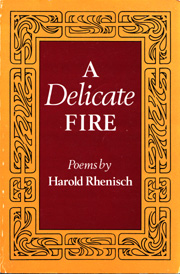
pp $8.95 Reviews Harold Rhenisch's poems are intensely gothic, sensual and profoundly perceptive. His thorough understanding of the natural world enables him to write both with precision and with an intuitive grasp of the forces beneath the surface. His portrayals of human relationships are subtle and he continues to meld together the profoundly philosophical and the wickedly funny. These poems have an enormous range and an impressive intellectual strength as well as emotional power. With this new collection, Rhenisch establishes himself as one of the leading Canadian poets of his generation." Robin Skelton There is a great range to these poems -- narrative, descriptive, reflective, meditative -- and they speak with a naturally powerful voice, an authority many of the best poets do not achieve until halfway through their careers. George Woodcock, B.C. Bookworld Rhenisch consistently displays his most memorable, unique gifts....his long presence and work on the land weave eloquently and seamlessly with erudition, high discourse, and the central issue of language....With these poems, Rhenisch joins the company of such elegant writers as Robert Hass and Linda Gregg, Don Coles, Sharon Thesen and John Smith, even Thomas Merton. Richard Lemm, Event What gives Rhenisch's work its uncommon depth is the constant tension between the natural world and the world of words and ideas in which he is equally at home. "The land as we hold it in words" he says, "is the land that words can hold,/but it is seen through loss/and not possession". From the understated compressed stories of the "He and She" and "This Land" sections, through the playful witty anthropomorphisms of Coyote and Crow to the culminating Canto-like synthesis of "The Koan", Rhenisch grafts intellect to intuition with the rigorous patience of a craftsman who finds the grain and works with it instead of just chopping wood. John Moore, The Vancouver Sun.
|
|
|||||||||||
from THE KOAN The filbert bush along my fence blossoms all witner and gives fruit, which when dried and crackedc can be eaten to give the taste of the wood, the blindness within the root of the filbert, the black lone-ness of the soil; the apple, when plucked from a black, wet limb three days after the first hard frost that has withered the tomatoes into their blight, and cupped with the blossom end to the fingers in the palm of a man's two hands, can be cracked in half to bring to light flesh that has not before seen light, which is white, unblemished, and there within, in a star-shaped, fibrous tissue which is the womb of this tree, a few brown and bitter seeds: so too is the mind not only a flower that can open and so provide a small bowl for light, said Chuang Tzu after a lifetime of concentration on concentration, but is also a seed, a flower that closes upon itself and, old and brittle, its petals withered and scattered, loses all shape of itself, so forming a kernel that can crack the teeth. The painter grows into his craft: he spends a lifetime above the lake, and so over time learns or rather re-learns&emdash; light, as it pours down over the hills and lights even the depths of the lake: yet it is not the mind that burns within his canvas, illuminating it, but the thick residue of those years of the sun pouring over his face: he is like a block of wood set aflame: by concentrating the light through the forms of his art, he so intensifies it that he is burnt away: there is no kernel, no completion. Similarly, it is not a useless acticvity to page through books to find the breath of living men, for you will soon find&emdash;yoor eyes going black with the realization&emdash;that it is a useless activity: it is better to go out and stand in the flood-raked, snapped-off stalks of sand-bar willow below the abandoned bridge of the Great Northern Railroad over the mercury shadow of the Similkameen River in the wind, your jacket snapping about you, the whole earth in motion, and clouds dissipating, in the force of the wind, directly into sky: it is a great industrial construction above you and blocks out the better part of the sky, but it is there: it is best, as Kung said, to do something in particular. The prophets of Greece before the invention of writing, claimed to have had, while sleeping, their ears licked out by snakes, and so were able to hear the speech of birds; the koan sets before you a purpose and the means to achieve that purpose, whereas the purpose itself is to have no purpose, and to strive to no end, but to be a receptacle, and so forces the mind to snap, and if there is no kernel there, it is because it is the world. back to top |
|
|
|||||||||||
|
|
|
||||||||||||
|
|
|
||||||||||||
|
|
|||||||||||||
|
|
|
|
|||||||||||
|
|
|||||||||||||