|
Harold Rhenisch
|
|
||||||||||||
|
|
Sono
Nis Press,
1993. ISBN: 1-55039-037-6 6 X9
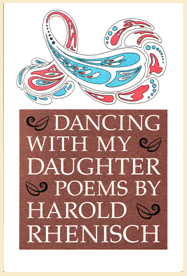
94pp $9.95 Dancing With My Daughter is Harold Rhenisch's fourth collection of poetry. Characteristically, the poems are alight with an ardent lyric impulse which is all the more intense for being shaped by an elegant restraint. The book is divided into three sections. The first shimmers with the surreal incandenscence of the poet's dreamworld. This is a rhapsody. Yet when the poet performs a dance with his daughter, it is as measured and grave as a gavotte. The second section of the book considers the meaning of the past as it persistently and powerfully permeates the present. In the third section, the poet constructs a viable bridge between the artist and the natural world around him.Finally, these poems are a celebration of the living past and a passionate present where all movement &emdash;in water, in the dance, in wind and in art&emdash;is a statement of re-creation. Angela Addison Drifting north from the Similkameen to the Cariboo, Rhenisch is a kind of Steppenwolf who manages to combine both the populism of wanna-be work poets and the subtleties of "poets' poet." The orchardist and the haiku poet both believe in the value of pruning, and there is a farmer's economy of effort which lends emotional and intellectual incandescence to very line Rhenisch writes. Reading him always makes you feel as though you're sitting at a farmhouse kitchen table late at night with a stack of books and a glass of something from the cellar, kids and stock safely abed, and an hour or two to talk quietly about what it all means. John Moore, The Vancouver Sun Rhenisch puts the whole of the poem down so carefully on paper that it becomes a wonder.Prairie Fire
|
|
|||||||||||
WATER This is not one of the Sefiroi that is burning, phosphorescent, in this dark room&emdash;the shape of the night is showing through the form of the room&emdash; but the scent that wafts from it is the scent of hay: it is a thing of light, a nest for birds, a jug that will hold no water: it is the body. Mountains and trees are also thin filaments of light: the mind, perfectly attuned, will look through them and see Nothing&emdash;they are the heavy seedheads of grass in rain; as soon as the body steps out of the door and the wind moulds itself exactly to its face, it ceases to be the body, but is the threshing floor; music is continually fighting to return to its first note, but no longer has within it the form of a tree&emdash;it can form the song of a tree, but can put forth no leaves, gently fingering the light like angels. I have just stepped out the back door into the sky. The light in the leaves under the apricot trees, and the light off the water on those leaves, to hold the frost from the roots, is reflecting the sky: the sun is burning within them&emdash; but cooled, and still. If you break apart the sacred geometry of the Sefiroi, you get no more than a heap of light on the ground, that quickly seeps out through the grass until it is a skin that so perfectly fits the shape of leaf-blade and gravel that it has unlearnt itself&emdash;and all so quickly that the mind does not see that it is there, or even that it was within its hands. With such visions the body walks down out of the bush, dark with rain, smelling of clouds, and simply to see the light burn up over its face and to feel the shadows of light burn down its throat as the door opens, knocks lightly on the door of the mind and asks for water. Music too tends to unlearn itself when thrown into the grass. The body sees all, and because it does not know what to make of it, and with what it knows cannot return into the water the mind has given it in a white pitcher, but can drink it, and so, bitterly, drinks&emdash;rain, and wind through alders, the moon shivering, a blur&emdash;and so shivers, it dreams; and those dreams are the mind. If you break apart the sacred geometry of the mind, you get the body: it smells faintly of a flame. You can learn much from it, like water poured down the throat out of the hands, directly into the rough wood-wind notes of a tree, so coarse they seem at first without relation to water. back to top |
|
|
|||||||||||
|
|
|
||||||||||||
|
|
|
||||||||||||
|
|
|||||||||||||
|
|
|
|
|||||||||||
|
|
|||||||||||||